
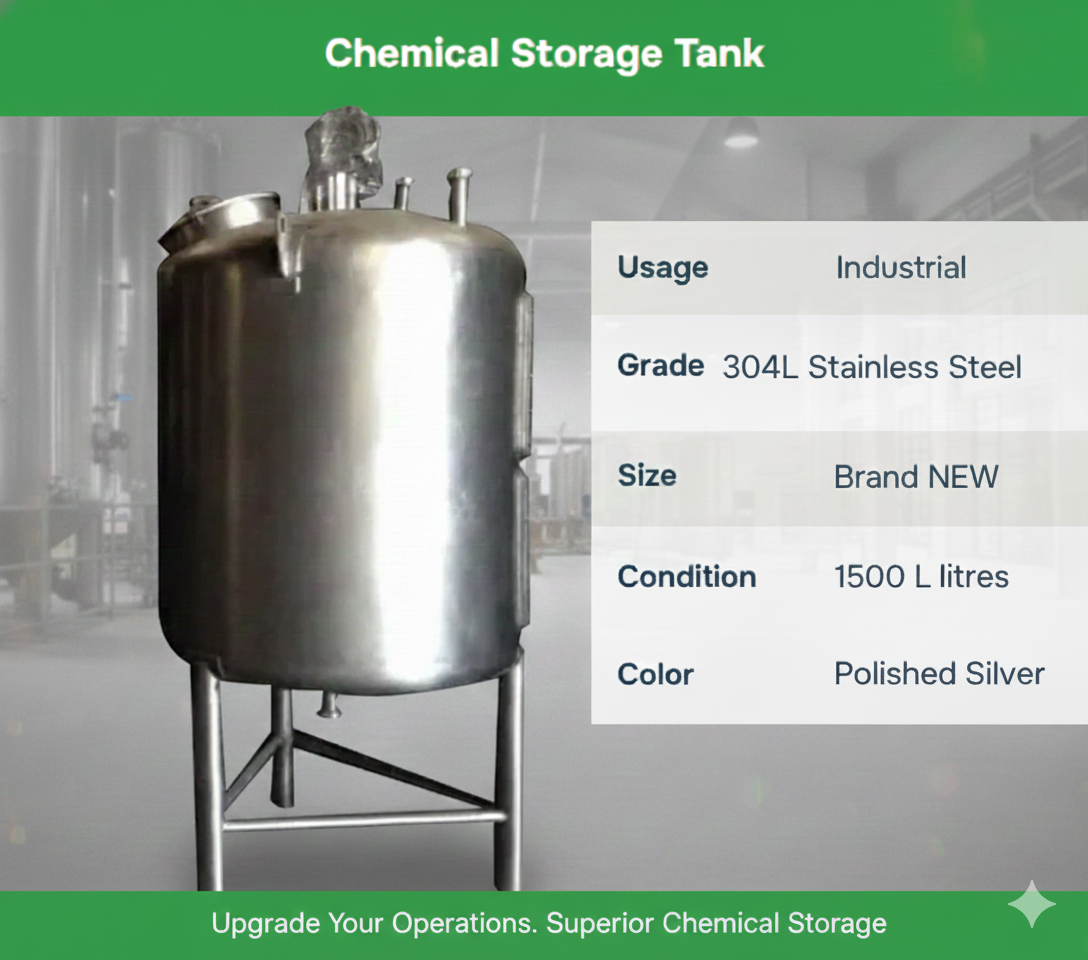
For industrial facilities, chemical storage tanks allow the safe storage of liquid/gas/hazardous chemicals and encapsulate the chemical until it is needed again (in either form). The materials and design used to manufacture the chemical storage tanks include safety features that ensure the protection of your staff, your equipment (tools, machinery), and the environment around you.
When designed and constructed correctly, chemical storage tanks will help reduce the chance of dangerous chemical fire or explosion due to a chemical reaction or leakage. Additionally, the tanks make it safer for employees, vendors, and customers to use the chemical when being handled, stored, and transferred; therefore, having the chemical storage tanks installed, inspected, and maintained correctly must be done in order to keep your facility in the safest and most efficient way.
Chemicals are often solids or liquids that are reactive and volatile in nature. All of these chemicals pose a risk to people, property, and the environment if not properly controlled. A chemical storage tank is capable of safely storing, mixing, and handling a variety of chemicals. A competent chemical storage tank will have experience and be familiar with the diversity among the various chemical properties. Some chemicals may be corrosive. Other chemicals may be flammable.
Different chemicals have their own specifications for temperature and pressure to achieve the proper functions. Because of these differences, the engineering of the equipment will need to consider the storage conditions of the chemical while administering those cold chain properties of the chemical to avoid leaks, reactions, and contamination of the chemical.
Chemical storage tank manufacturers utilize technology-based processes with and without humans to enhance product quality and processes. Robotic welding, 3D modeling, and ultrasonic inspection are just a few examples of processes that can identify structural problems in the tank's construction before those tanks are shipped to the end user.
Robotic welding: Guarantees that the welds in the failure joint of the tank are accurately placed and thus contributes to the structural integrity of the tank and the safety performance of not leaking.
3D modeling and simulation: Data provides engineers with assurance that the design takes into account the pressures and stresses that occur in the tanks, and then engineers can modify the design in the model.
Ultrasonic or Hydrostatic Testing: Each performs a nondestructive test on the welds to confirm the integrity of the welds for cracks and also confirms the integrity of the tank under pressure. Technology-based manufacturing processes eliminate human errors that would greatly affect the reliability of the safety and performance.
Setting and Suitability of Foundation
A proper foundation will ensure that the tank does not tip, crack, and/or have pressure differentials. The manufacturer assists the construction teams on how to best prepare the foundation for the tank.
Safety Protocols During Installation
While the tank is being installed, the installation teams will need to continue according to the safety protocol(s): wearing personal protective equipment, using cranes or lifts safely, and staying clear of electrical lines or heat sources.
Even a well-designed tank still requires maintenance. A dependable chemical storage tank will provide maintenance schedules and may provide after-sales services for inspection and maintenance.
Routine Inspection
Routine inspections help to identify any leaks, rust, or corrosion at an early stage. Sensor readings for pressure and level should be calibrated to ensure proper readings.
Cleaning and Decontamination
Depending on the stored chemical, a tank will require cleaning to avoid the buildup of residues that could be ignited or react with incoming product. Manufacturers often highlight cleaning agents to be used in specific methods.
Repair and Replacement
When a tank appears to be damaged or has been in use for a number of years, it is better to perform early repairs to avoid unrecoverable failure. Many manufacturers also offer replacement components or to replace the entire tank to comply with safety regulations.
A chemical storage tank serves the important function of protecting the environment. Improper storage of chemicals can lead to soil contamination, pollution of waterways, and degradation of air quality. Taking the necessary steps to build much stronger tank systems with secondary containment features, spill containment, and corrosion-resistant materials allows the supply industry to help lessen the environmental effects.
Ensuring safety is not just an ethical obligation but also a wise financial practice. A single spill of a chemical element may prompt a company to spend millions of dollars, which not only includes the repair expenses but also expenses due to the loss of productivity, reputation, and brand damage.
Partnering with an experienced chemical storage tank provider ensures long-term cost savings from:
Suppliers are investing in smart monitoring systems, automated sensors, and predictive maintenance using AI. These technologies will help detect leaks and pressure fluctuations early and automatically send notifications to operators before a serious incident occurs.
In addition, vendors are expanding their supply of sustainable materials and modular tank systems that can be easily expanded or relocated with much less material and waste
A future-oriented chemical storage tank is aware that sustainability and automation are the future's direction—two pillars to ensure that industries are safer and smarter.
If you are looking for a dependable partner that has the technology and safety know-how, RCrisp Solutions is a trusted name. With years of experience and a focus on educational excellence, RCrisp Solutions develops tanks engineered to provide the highest level of safety and reliability.
Copyright © 2026 RCRISP SOLUTIONS INDIA PRIVATE LIMITED | All Rights Reserved. Website Designed & SEO By Webclick® Digital Pvt. Ltd. Website Designing Company India